
I have a confession. I once spent an entire Saturday watching nature documentaries while sitting six feet from a perfectly good back door. Kevin Costner was narrating the wonders of Yellowstone. I was eating banana chips. In my defense, I intended to go outside. I even put on shoes. Then I sat down “just for a minute” and the next thing I knew it was dark and I had strong opinions about buffalo.
Turns out, science has something to say about people like me. Dr. Rachel Hopman, a neuroscientist who studies relaxation and the brain, developed what she calls the 20-5-3 Rule — a nature prescription so simple and reasonable - I call it justification- and it works everytime. And since Trailbuds & Co exists at the intersection of getting outside and doing it safely and smartly, this rule deserves a full breakdown. Because here’s the thing — if you’re hiking, you’re already ahead in the game.
What Exactly Is the 20-5-3 Rule?
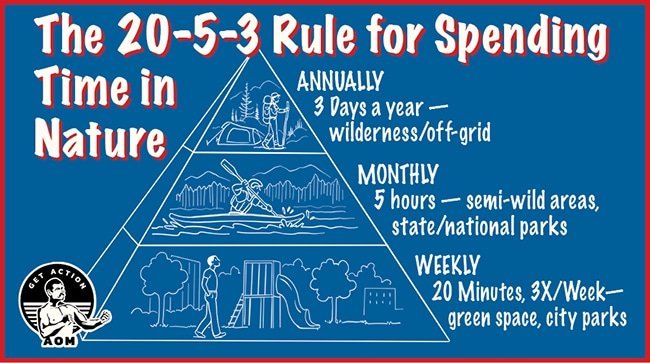
Think of it like a nature pyramid. Dr. Hopman built her framework on the idea that the more time you spend in nature — and the wilder that nature is — the greater the benefit to your brain, your stress levels, and your overall wellbeing. The rule gives you three manageable targets to work toward.
20 = 20 minutes in a green space, at least three times a week.
5 = 5 hours a month in a semi-wild environment.
3 = 3 days a year fully off the grid.
That’s it. No gym membership. No equipment. Just you, outside, putting down your phone.
Step-by-Step: How to Actually Do This
Step 1 — Start with your 20 minutes, three times a week.
This is the entry level and it counts more than you think. Research from the University of Michigan found that 20 minutes outside is enough to lower your body’s cortisol — your primary stress hormone. And here’s the best part: it doesn’t have to be a wilderness area. A pocket park, a community garden, or even a tree-lined street counts. The catch? People who used their cell phone during the walk saw none of the benefits. Put. The. Phone. Down. Yes, that means you can’t Instagram the walk to prove you went on the walk.
Step 2 — Build up to 5 hours a month in semi-wild nature.
This is where hikers naturally shine. A state park, a trail system, a day at the beach — anything that gets you away from concrete and closer to trees. Dr. Hopman describes what happens to your brain outside as entering a “soft fascination mode” — like a walking meditation without the meditation. Your mind is noticing, repairing, and filing things away even when you’re not aware of it. Essentially, your brain loves being outside more than it loves your inbox. Shocking, I know.
Step 3 — Go off the grid for 3 days, once a year.
I LOVE this one. I can see myself doing a long weekend in Costa Rica rebelling the waterfalls. (on my bucket list). This is the top of the pyramid and yes, it sounds dramatic, but stay with me. These extended nature experiences activate brain waves called alpha waves, which encourage relaxation and creativity, and can reduce stress levels for weeks afterward. Three days. One time a year (oh darn only 3!) A camping trip, a cabin with no WiFi, a backpacking adventure — it all counts. The point is to fully unplug and let your brain remember what quiet actually feels like.
Mistakes to Avoid
Bringing your phone out and calling it nature time. Scrolling Instagram in a park is still scrolling Instagram. The research is clear — phone in hand means zero benefits. Leave it in your pocket.
Saving it all for one big trip. Five hours once a year doesn’t replace 20 minutes three times a week. The rule works because it’s layered — each level builds on the last. You can’t skip straight to the mountain top (literally or figuratively).
Thinking your hike has to be epic to count. A short easy trail through a neighborhood greenway absolutely counts for your weekly 20. Not every outing needs to be a summit attempt. Some days the win is just being vertical and outside.
Going off-grid unprepared. The 3-day immersion is where this rule intersects with everything we preach at Trailbuds & Co. Three days off the grid is not three days without a plan. It means your SOS Pak is packed, someone knows where you are, and you’ve done the pre-hike checklist.
Waiting until you “have time.” You don’t find 20 minutes. You make 20 minutes. Let me repeat that again…You don’t find 20 minutes. You make 20 minutes. Walk at lunch. Park farther away. Ok, I have to stop here. I think it is so funny that when people go shopping they look for the closest parking space. They will go round and round a parking lot until one opens up. Does anyone see the irony in that? lol. Ok off my soapbox. Take the dog out for a longer loop. The bar is genuinely low — which is the whole point of the rule.
Your 20-5-3 Quick-Start Checklist
• Identify a green space within 10 minutes of home or work
• Schedule three 20-minute outdoor blocks into your week right now
• Find one semi-wild location within an hour of home for your monthly 5 hours
• Pick a weekend this year for your 3-day off-grid reset — put it on the calendar
• Download offline maps for all planned locations
• Pack your SOS Pak (coming summer ‘26) for anything beyond a neighborhood stroll
• Leave your phone in your pocket during your 20-minute sessions
Final Thoughts
A neuroscientist had to publish research to convince us to go outside.? No, not us. Or maybe just gave us good line for us to tell a spouse or our non hiking friends. We live in a time when doctors are literally prescribing park walks.
Here’s what I keep coming back to every time I’m on a trail with Molly, even when it’s a short one, even when I forgot half my gear (ask me about that sometime) — the trail always delivers. Twenty minutes. Five hours. Three days. It doesn’t matter the dose, nature just works.
So close the nature documentary. Put on the actual shoes. And this time, walk out the door.
Safe trails, smart choices, and always — have fun out there.
Trailbuds & Co
